Thirteen Artists Whose Health Conditions Changed Their Creative Process
There is a version of this story that I find less useful the longer I work in this field. It is the version where an artist faces illness or disability, pushes through, and produces great work anyway. The word “anyway” is doing a lot of work in that sentence. It sets up health as the thing to be overcome, and the art as the proof that it was.
What I have found, across years of research into how health shapes creative practice, is that the relationship between condition and work is rarely adversarial in the way that story implies. In the cases below, the condition was not on the outside, pressing against a creative life from without. It was inside the process. Inside the materials, the methodology, the timing, the collaborations, the very way the work got made.
None of these thirteen artists overcame. Some of them were killed, institutionalized, or worked through decades of inadequate or absent care. The work that remains is not a testament to triumph. It is a record of what happens when a creative practice is built from the actual conditions of a life, including the health conditions, rather than in spite of them.
I offer these profiles as a reference, and as a companion to the longer thinking I have been doing about what this means for artists navigating health now.
Evelyn Glennie, b. 1965, Scotland. Deaf percussionist.
Glennie began losing her hearing at eight from progressive nerve deterioration and was profoundly deaf by twelve. She was told by the Royal Academy of Music that a deaf student in the percussion program would be inappropriate. She was accepted and graduated with the highest honors of her year. What she built in place of conventional hearing is a distributed somatic relationship to sound: frequencies felt in the legs, chest, face, and neck. She performs barefoot so vibrations travel directly from the floor into her body. The methodology she developed is more physically integrated than what most hearing percussionists ever build, because they never have to.
Francisco Goya, 1746-1828, Spain. Deaf painter.
Goya was forty-six when a severe illness left him profoundly deaf overnight. He continued his court commissions for years. Then he witnessed the French invasion of Spain in 1808 and the six years of war that followed, and he watched it all in enforced silence. After the war, he moved to a country house outside Madrid already carrying the name Quinta del Sordo, the Villa of the Deaf. Between 1820 and 1823, he covered the interior walls with paint directly on plaster: fourteen paintings, no patron, no commission, no intended viewer except himself. The Black Paintings, Saturn devouring his son among them, were discovered after his death. The solitude the deafness enforced, compounded by the trauma he had witnessed, produced the working conditions for the darkest and most private body of work he ever made.
Georgia O’Keeffe, 1887-1986, United States. Painter with macular degeneration.
Macular degeneration began affecting O’Keeffe’s central vision around 1971, when she was in her early eighties, and by 1972 she had lost most of it and stopped painting. She began working in clay instead, which does not require the same visual precision. A young potter named Juan Hamilton came to work for her as an assistant and introduced her to pottery seriously. She made clay pots and forms through the late 1970s, then returned to painting at larger scale with bolder marks her remaining peripheral vision could manage. She died at ninety-eight, still making. The vision loss did not end the practice. It moved it.
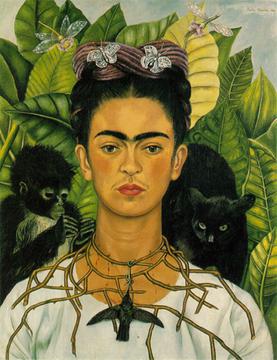
Frida Kahlo, 1907-1954, Mexico. Painter with multiple chronic conditions following bus accident.
Kahlo was eighteen when a bus accident fractured her spinal column, collarbone, and ribs, fractured her right leg in eleven places, and drove a steel handrail through her hip and out through her pelvis. Her mother had a special easel built for use while lying down. A mirror was installed in the canopy of her bed. She painted herself because she was the subject available to her in the position she was in. She underwent thirty-five surgeries across her lifetime. The self-portraits that came from that horizontal studio are among the most psychologically precise paintings of the twentieth century. The constraint is not incidental to the work. The constraint is in the work.
Django Reinhardt, 1910-1953, Belgium. Romani jazz guitarist with severe hand injury.
Reinhardt was eighteen when a caravan fire in November 1928 severely burned his left hand, fusing the ring and little fingers into a curled position he could not straighten. The guitar requires four fingers on the fretting hand for conventional harmonic range. He had two that could extend. During his recovery he rebuilt his relationship to the instrument entirely, inventing a technique in which the index and middle fingers carried all the melodic work while the fused fingers found their way into chord shapes that a conventional undamaged hand would never arrive at. The style that came from that technique is what we now call jazz manouche. The style is the reinvention. The reinvention is the art.
Dorothea Lange, 1895-1965, United States. Photographer with polio.
Lange contracted polio at seven, leaving her right leg significantly weaker and giving her a characteristic limp she carried throughout her life. She spoke directly about it late in her life: “It was the most important thing that happened to me. It formed me, guided me, instructed me, helped me and humiliated me all at once. I’ve never gotten over it and I am aware of the way I walk.” She moved through spaces differently than a fully mobile person moves, more slowly, more attentively to terrain. She was less threatening to approach in a migrant camp than a healthy man striding through with a camera. Her subjects had more time to adjust to her presence before she lifted the camera. Migrant Mother, 1936, is a photograph made by the body Lange was in.
Yayoi Kusama, b. 1929, Japan. Visual artist with neurological hallucinations.
Kusama has experienced neurological hallucinations since childhood: flowers speaking to her, dots and nets spreading across every surface until they covered her own hands and body. She began painting the hallucinations as a child, surrounding the perceptual experience with itself in paint and fabric and mirror until the fear reduces. She calls it art therapy. Since 1977 she has lived by her own choice in a psychiatric facility in Tokyo, walking each day to her nearby studio. She is now in her late nineties and among the most commercially recognized living artists in the world. Every dot started as a hallucination.
Martín Ramírez, 1895-1963, Mexico/United States. Institutionalized artist.
Ramírez immigrated to California in 1925 for railroad and mining work. Around 1930 he stopped speaking. He was institutionalized and eventually placed at DeWitt State Hospital in Auburn, California, where he would spend the rest of his life. His diagnosis was dementia praecox. He began making drawings from whatever materials the hospital offered: brown paper bags, scraps of mail, toilet paper. He made paste from breadcrumbs and saliva. He used shoe polish for color. The drawings depict tunnels and arcades and landscapes receding into impossible depth, trains and deer and Madonna figures and animals. A psychiatrist named Tarmo Paloheimo began collecting them in the 1940s rather than destroying them, then standard practice. Ramírez had no language. The drawing was the only communication available to him. His work is now held in major international collections.
Virginia Woolf, 1882-1941, United Kingdom. Novelist with severe mental illness.
Woolf navigated severe mental illness across her adult life, with extended periods of incapacitation during which she could not read, write, or think coherently, sometimes lasting months. She tracked these states in her diary with remarkable precision, learning when to push and when to rest, what kinds of work were possible in which states. The Waves was written during a period of creative energy she described as intense and sometimes frightening in its speed. Mrs. Dalloway came after a breakdown, in relative stability. To the Lighthouse was written across a period of fluctuating health. The shape of each book is partly the shape of the mental state in which it was written. She died by suicide in March 1941, walking into the River Ouse with stones in her coat pockets.
Nina Simone, 1933-2003, United States. Musician with bipolar disorder, diagnosed late.
Simone applied to the Curtis Institute of Music in Philadelphia and was rejected. She and many others believed it was because she was Black. She spent her career navigating both racism and what was eventually, much later in her life, diagnosed as bipolar disorder, a condition that went untreated or mistreated for decades while being attributed to her personality. Her performances were notoriously unpredictable. She might play two hours beyond the contracted set or walk off mid-song. She left the United States in 1974, living in Liberia, Switzerland, the Netherlands, and France, with long periods of not performing at all. She received her diagnosis in 1991, in her late fifties. The rhythm of her career was organized by her condition whether she understood it as such or not.
Charlotte Salomon, 1917-1943, Germany. Painter killed at Auschwitz.
Salomon grew up in a family marked by multiple suicides across generations. She fled Nazi Germany for the south of France in 1939. Between 1940 and 1942, while hiding near Nice and knowing what was coming for her, she created Leben? oder Theater? (Life? or Theater?): 1,325 gouaches on small sheets of paper, a complete autobiographical account of her life and family painted with musical references and overlaid text. When she finished, she gave the full stack to her doctor and said: “Keep this safe. It is my whole life.” She was deported to Auschwitz in September 1943 and killed on October 10, 1943. She was twenty-six and five months pregnant. The work survived because her doctor kept it. It is held at the Jewish Historical Museum in Amsterdam.
Keith Haring, 1958-1990, United States. Visual artist with HIV/AIDS.
Haring built his reputation through chalk drawings in the New York City subway system, on the black paper covering unused advertising spaces, and through gallery shows and large-scale international commissions. He was diagnosed with HIV/AIDS in 1988, at thirty. He disclosed his diagnosis publicly. He founded the Keith Haring Foundation in 1989 to support AIDS organizations and children’s programs, opened the Pop Shop to generate foundation income, completed major mural commissions internationally, and collaborated with ACT UP. He kept making. The work from his final two years is more direct about mortality and loss than the earlier work. He died in February 1990 at thirty-one. His final two years are the ones most closely associated with his name.
Judith Scott, 1943-2005, United States. Fiber sculptor with Down syndrome and deafness.
Scott was born with Down syndrome and deafness, institutionalized at seven, and remained in state institutions for thirty-five years until her twin sister Joyce became her legal guardian in 1985. In 1987, Judith was enrolled at Creative Growth Art Center in Oakland. For nearly two years she made very little. Then a visiting fiber artist named Sylvia Seventy offered a class. Judith walked in and picked up the fiber. She did not weave. She wrapped, small objects at first, then larger ones, then person-sized sculptures of dense, layered yarn and thread concealing found objects inside. She worked for eighteen years until her death in 2005, producing more than two hundred pieces now held in major international collections. She had no verbal language. The fiber wrapping was the form through which a particular interior world could be expressed.
What these thirteen artists share is not resilience in the popular sense, not the defiance of their conditions or the triumph over them. What they share is that the condition was inside the process. It shaped the methodology. The methodology shaped the work. The condition and the work are not in separate columns.
This is a different claim from the overcoming story, and I think it is a more useful one for artists navigating health now. The question is not how to continue making in spite of a health condition. The more useful question is what the condition is doing to the process, and what the process is becoming in response. These thirteen lives suggest that the answer, more often than we are told, is something real and particular and worth attending to.
If you are an artist navigating this territory and you want support in mapping exactly how your health is showing up in your creative practice, that is the work I do.