Tag: sustainable creative practice

  • What Happens in a 1:1 Creativity and Wellness Session?

    What Happens in a 1:1 Creativity and Wellness Session?

    Support for artists, writers, and creatives navigating change, disconnection, or burnout

    My 1:1 sessions are designed for people whose creative work has been impacted by health, trauma, burnout, or identity shifts. These sessions are a space to pause, reflect, and re-enter your creative life with clarity and care.

    Here’s what to expect.

    Who the Sessions Are For

    is creativity coaching for you

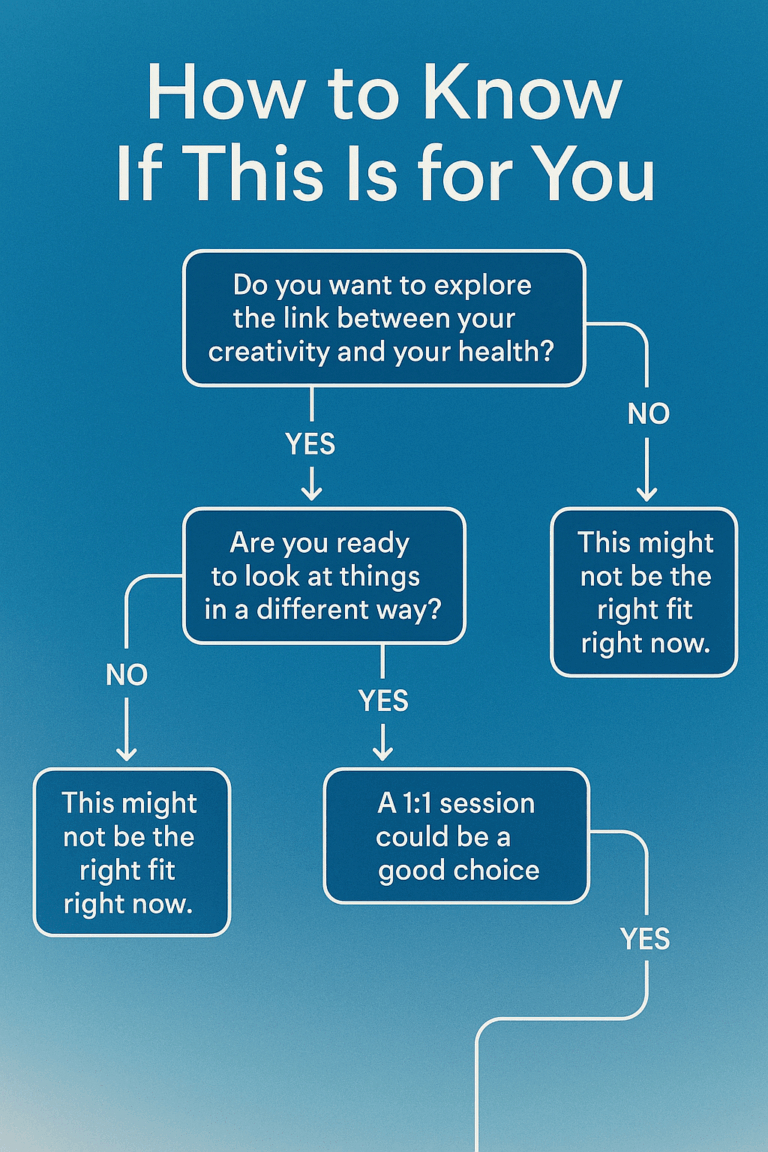
    These sessions are ideal for:

    • Creatives who feel disconnected from their work or voice

    • Artists navigating chronic illness, grief, or life transition

    • Neurodivergent writers who need rhythm, not rigidity

    • Therapists or helping professionals ready to focus on their own creative process

    • Anyone burned out by hustle culture who wants a more sustainable way to create

    You don’t need to be producing consistently. You don’t need a portfolio or a goal. You only need a desire to reconnect with your creative self.

    What Makes These Sessions Different

    This is not a productivity session. It is not therapy. It is also not traditional coaching.

    Instead, this is creative space informed by:

    • My background in psychology and expressive arts

    • My research in craft as healing

    • My lived experience with chronic mental health conditions

    • My years of working with writers, makers, and sensitive creatives

    I work at the intersection of creativity and health. I hold space that acknowledges the body, the nervous system, and the emotional reality of making things while living through difficult seasons.

    what is a creative guidance conversation

    What Happens During the Call

    Each session is 60 minutes via Zoom.

    We begin with a gentle check-in. I might ask where you are in your process, or what’s been feeling hard or heavy. We explore patterns, pace, and pressure. We talk about what’s been lost, what still feels true, and where you want to go next.

    You are invited to speak freely. You can show up messy, uncertain, vulnerable, or quiet. These sessions are not about performance. They are about presence.

    Most sessions end with a reflection or small creative next step, tailored to your real life and energy.

    What You Leave With

    • Language for what’s been happening in your creative life

    • Tools or practices to support your current capacity

    • A sense of validation and calm

    • Gentle guidance instead of pressure

    • A clearer understanding of how to keep moving, even when the pace is slow

    How to Get Started

    You can book directly through the link below. I’ll send a short intake form beforehand, just to get a sense of where you are.

    📅 Schedule Your Session
    📩 Questions? Email me: [email protected]

    You do not need to wait until things feel easier.
    We can begin from where you are.

  • Creative Procrastination Isn’t a Problem

    Creative Procrastination Isn’t a Problem

    Why delaying your creative work is often a form of intelligence, not failure

    Why delaying your creative work is often a form of intelligence, not failure

    Procrastination is one of the most common concerns creatives bring into my sessions.

    “I don’t know why I keep avoiding this project.”
    “I’ve been staring at the same page for weeks.”
    “I want to make something, but I can’t get started.”

    In creative culture, and especially in professional spaces, procrastination is often framed as laziness or resistance. But what I’ve found, both in my own work and with the artists and writers I support, is that procrastination is rarely the real issue. It’s a signal. A protective strategy. A nervous system adaptation trying to help.

    In other words, creative procrastination isn’t a problem. It’s a pattern. And like all patterns, it can be understood, honored, and reworked into something more aligned.

    Why Creatives Delay (Even When They Care Deeply About the Work)

    When someone delays creative work, it’s usually for one of the following reasons:

    • Their nervous system doesn’t feel safe enough to begin

    • Their perfectionism has overridden their sense of play

    • Their internal critic is louder than their curiosity

    • Their body or mind is in a state of overwhelm, freeze, or fawn

    • The emotional cost of starting feels too high to risk

    These reasons are not excuses. They are context. They often originate from lived experiences of trauma, burnout, rejection, or identity suppression.

    Procrastination, in these cases, is the body’s way of saying:

    “This might hurt. I’m not ready. Please wait.”

    That message deserves respect. It also deserves tools that help creatives move forward at a pace that doesn’t trigger collapse.

    procrastination and creative productivity

    The Role of the Nervous System in Creative Avoidance

    Many of the creatives I work with live with chronic illness, neurodivergence, or trauma histories. Their nervous systems are not always operating in the background. Often, they are central players in how (and when) creative work gets done.

    A person in fight or flight may push themselves through deadlines, then crash.
    A person in freeze may go numb and call it laziness.
    A person in fawn may agree to projects they cannot complete without depletion.

    Understanding these patterns allows us to reframe procrastination. It is not resistance to creativity. It is an attempt to regulate safety. And once that need is recognized, the solution is not to push harder. It is to meet the body where it is.

    A More Helpful Question Than “Why Am I Delaying?”

    Instead of asking “Why can’t I just do it?” I help clients ask:

    • What does this delay protect me from?

    • What would I need to feel safe enough to start?

    • What does the task represent emotionally?

    • What is the smallest first step that feels accessible?

    • Can I approach this as an experiment, not a test?

    Often, these questions uncover deeper creative truths. They also create pathways back to the work that are grounded in care, not pressure.

    procrastination isn't a creative problem

    What This Means for You or Your Clients

    If you are a creative person who struggles with procrastination, or if you support people who do, consider this:

    You may not need to fix the delay.
    You may need to understand the story behind it.
    And once that story is named, the work can begin—gently, differently, and in your own time.

    In my 1:1 Creativity and Wellness Sessions, we explore the emotional, psychological, and physical context of your creative life. We look at where avoidance shows up, what it is trying to do for you, and how to shift it without shame. This is not productivity coaching. It is permission to return to your work with softness and strategy.

    Book a Call Today

    You do not have to push through. You just have to begin where you are.