Tag: slow creativity

  • When Rest Is the Practice: Redefining Productivity for Artists

    When Rest Is the Practice: Redefining Productivity for Artists

    Rest is not a reward for finishing your work.
    Rest is part of the work.

    This may sound simple. But for many artists, writers, and makers, it’s a radical shift.

    We are taught to measure our value by output. Even in creative fields that claim to prize originality, we’re surrounded by metrics — posts per week, projects per year, word counts, launch schedules.

    But what if real creativity needs something else? What if your most important work begins not with doing more, but with learning to rest?

    Why Rest Feels So Hard for Creatives

    Most artists are deeply driven. We care about our work. We feel guilty when we’re not making progress. We fear falling behind, being forgotten, or losing momentum.

    We also live in a culture that romanticizes burnout and idolizes hustle. In that context, rest feels like weakness. Stillness feels like giving up.

    But in reality, chronic pushing often leads to:

    • Creative depletion
    • Emotional disconnection
    • Flattened ideas
    • Physical or mental health crashes

    What we call “slowing down” may actually be the start of returning to ourselves.

    What Happens When You Make Rest Part of the Process

    Rest is not the opposite of productivity.
    It is what allows your creative process to continue.

    When rest is integrated into your rhythm:

    • Ideas percolate more naturally
    • Your nervous system has space to recover
    • You reconnect to intrinsic motivation, rather than fear-based urgency
    • You begin to make from a place of enough-ness, not scarcity

    You are not a machine. You’re an organism. You grow through cycles — including stillness.

    What Creative Rest Can Look Like

    Not all rest looks like napping. For creatives, rest can mean:

    • Saying no to projects that don’t align
    • Taking breaks between drafts or phases
    • Switching mediums to rest your brain
    • Spending time consuming nourishing art
    • Going on a walk without a podcast
    • Letting something be “in progress” without forcing an outcome

    Rest is creative. It gives shape to your work by creating space around it.

    Letting Go of Linear Productivity

    You might not produce in tidy timelines. You may need to move in seasons. That doesn’t make you lazy. It makes you alive.

    Linear productivity says: keep going.
    Creative productivity says: listen and respond.

    If you’ve been stuck, exhausted, or doubting yourself, consider this: maybe the answer isn’t to push through. Maybe the next step is to pause.


    Need support redefining productivity on your own terms?

    I offer personalized reflections for artists and writers who want to reconnect with their creative rhythm. I’ll read your past work and help you understand how your health and creative flow are intertwined.

    Explore the Art Meets Health Creative Wellness Blueprint

  • A Framework for Creative Health: Six Dimensions of Insight and Reconnection

    A Framework for Creative Health: Six Dimensions of Insight and Reconnection

    six ways health impacts art

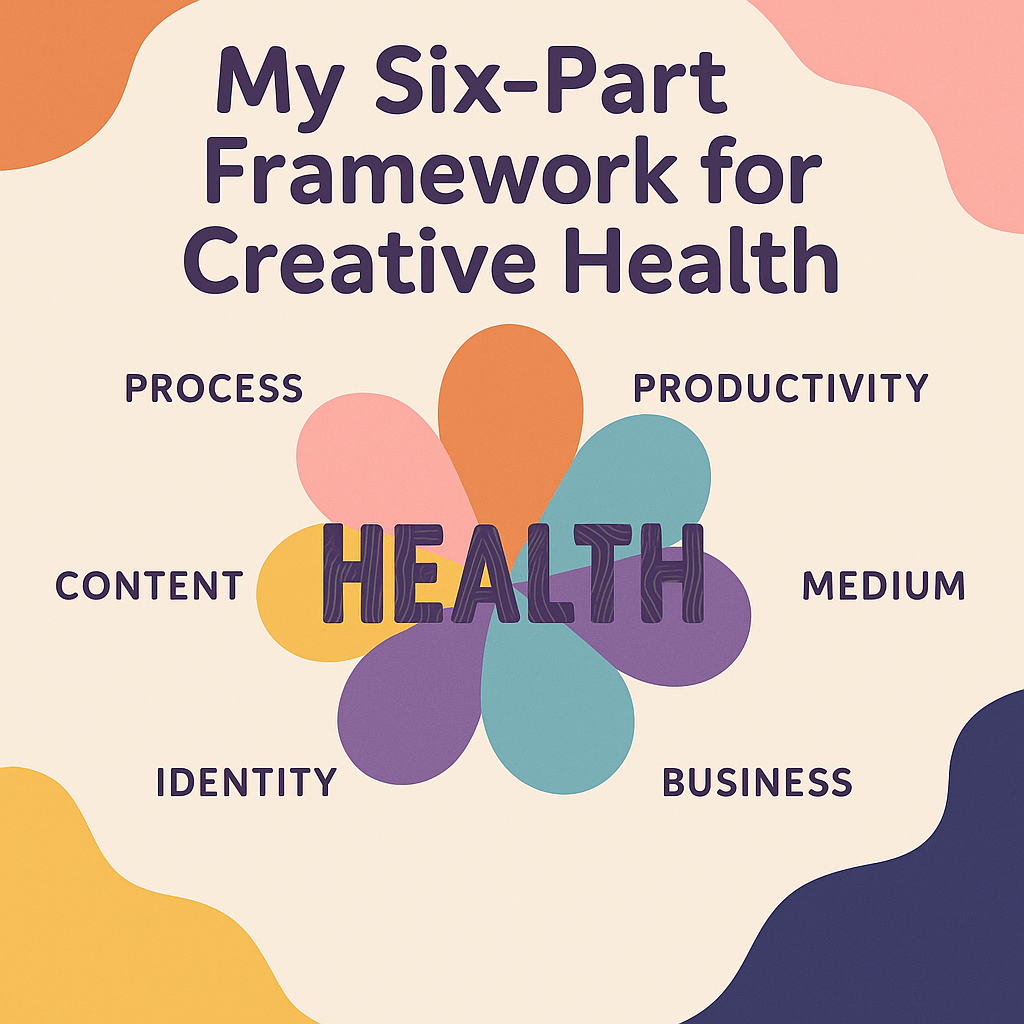
    When creatives come to me feeling blocked, inconsistent, or confused about who they are in their work, what we uncover is often far deeper than a temporary disruption in motivation. What we are seeing is a change in creative health—an interwoven network of patterns, needs, and beliefs that shape how a person relates to their art. This six-part framework offers a reflective structure to help name and explore these changes. Each domain is a point of inquiry, not a diagnostic category. The purpose is not to fix what is not working, but to understand what the work is responding to.

    1. Creative Process

    This refers to the how of your work. How do you approach making? What rhythms, rituals, or environments support your ability to enter a creative state? For many people, process becomes a source of anxiety when old methods stop working. Maybe you used to thrive on early mornings or long uninterrupted stretches, but now your health, schedule, or cognitive patterns require shorter, less structured sessions. This does not mean you are less committed. It means your process is asking to be reconfigured in a way that honors your current reality.

    2. Productivity Patterns

    Here we explore the when and how much. Creative identities are often tied to output, but this framing can collapse under the weight of chronic illness, burnout, or shifting priorities. Are you expecting yourself to work at a pace that no longer matches your capacity? Are you equating slow periods with failure? Noticing the mismatch between expectation and ability is essential. Productivity is not a measure of worth. It is a reflection of energy, accessibility, and alignment.

    3. Medium or Modality

    Sometimes the work itself wants to change form. This might mean shifting from writing to movement, from performance to collage, or from digital to tactile materials. These changes are not arbitrary. They reflect subtle psychological needs—whether for containment, expression, safety, or control. In my own experience, I have turned to fiber arts when language felt too sharp. Stitching became the way I reentered creative space when words could not yet hold what I was feeling. When your primary medium no longer feels accessible, it may be time to ask what your nervous system is reaching toward instead.

    4. Creative Content

    This is the what of your work. What themes or truths are you exploring, and have those themes shifted? Many creatives experience discomfort when they no longer feel drawn to the same subjects. They may feel bored, emotionally distant, or even resistant to what they once felt called to express. This is natural. We change. Our stories deepen or move. Allowing your content to evolve can feel risky, especially if your public identity has been tied to a particular genre or topic. But that evolution is often where your most honest work begins.

    5. Self-Perception

    This domain focuses on how you see yourself in relation to your creativity. Do you still identify as an artist, a writer, a maker, if you are producing less or working differently? Many clients carry shame around changing output or style because they have internalized narrow definitions of what it means to be a real creative. Revisiting and updating those definitions is often the most healing work we do. You are not required to create in the same way forever in order to be legitimate. You are allowed to shift and still belong to your creative identity.

    6. Sustainability and Long-Term Support

    Finally, we look at whether your creative life is built in a way that supports longevity. Can you keep doing what you are doing without crashing? Are your systems, boundaries, and goals aligned with your physical and emotional health? This is often the point where the body speaks loudest. A sustainable practice is one that leaves room for fluctuation, for illness, for grief, and for joy. It does not ask you to be consistent above all else. It asks you to be honest, supported, and resourced.

    Want to work on this with me? Book a session now.