Tag: neurodivergent creatives

  • The Invisible Cost of Pushing Through: What Creatives Miss When They Ignore Their Bodies

    The Invisible Cost of Pushing Through: What Creatives Miss When They Ignore Their Bodies

    You’ve probably heard it — or said it — before: “I just need to power through.”

    Maybe it’s a deadline. A burst of inspiration you don’t want to lose. Or the lingering belief that pushing through pain is part of being a “real” artist.

    But over time, that habit can cost you more than you realize.

    When you ignore your body to stay creatively productive, you create an internal split. One part of you makes the work. The other part pays for it.

    Why We Push Through

    Creative culture often romanticizes the idea of suffering for the work. It says things like:

    • “The muse comes at midnight.”
    • “If you’re not exhausted, you’re not serious.”
    • “Pain makes the best art.”

    That story is old. And it is dangerous.

    Many artists and writers have internalized the belief that their body is an obstacle to creativity — that illness, fatigue, pain, or slowness must be pushed aside to stay “legitimate.”

    Especially for people living with chronic illness, mental health challenges, or neurodivergence, this belief becomes a cycle of harm.

    What Gets Lost When You Ignore Your Body

    You may get the piece finished. You may meet the deadline.

    But here’s what you lose:

    • Long-term sustainability
      You burn out. You start associating your work with dread or pain. The thing that once brought you joy becomes a source of pressure.
    • Honest self-connection
      When you ignore your body, you train yourself to ignore other signals too — like intuition, desire, and authentic creative flow.
    • Creative adaptability
      Pushing through often means doing things one way, no matter the cost. You miss the chance to find rhythms, formats, or mediums that might work better for you.

    What Listening Looks Like Instead

    Listening to your body doesn’t mean never pushing yourself. It means discerning when to rest, how to create, and whatyou need to stay well.

    It might look like:

    • Changing your format to better suit your energy
    • Pausing a project to recover instead of forcing a finish
    • Working in bursts and then stepping away without guilt
    • Noticing when your art becomes a coping mechanism instead of a choice

    Your body is not the enemy of your creativity. It is the container for it.

    You Don’t Have to Earn Rest

    You don’t need to crash in order to rest. You don’t need to justify your exhaustion. You don’t need to make up for your limits with productivity.

    Creative work that honors your body is more sustainable, more honest, and more alive.


    Want help exploring how your health is showing up in your creative work?

    I offer personalized assessments based on your existing blog or Substack. I read your archive, pull meaningful quotes, and reflect how your well-being and creativity are already in conversation.

    Learn more about the Art Meets Health Creative Wellness Blueprint.

  • How Freeze, Fawn, and Emotional Shutdown Impact the Creative Process

    How Freeze, Fawn, and Emotional Shutdown Impact the Creative Process

    creative stress responses

    Understanding trauma responses in creative professionals and how to offer meaningful support

    Creative people are often described as expressive, passionate, and emotionally driven. But what happens when they go quiet? What happens when the writer no longer writes, the artist avoids the studio, or the maker forgets what it feels like to create?

    In my work as a creative wellness guide, I meet clients who aren’t creatively blocked in the traditional sense. They’re not resisting their work. They’re disconnected from it. They’re not overwhelmed by deadlines. They’re overwhelmed by silence. Many describe feeling numb, flat, or emotionally distant from the work that once brought them joy.

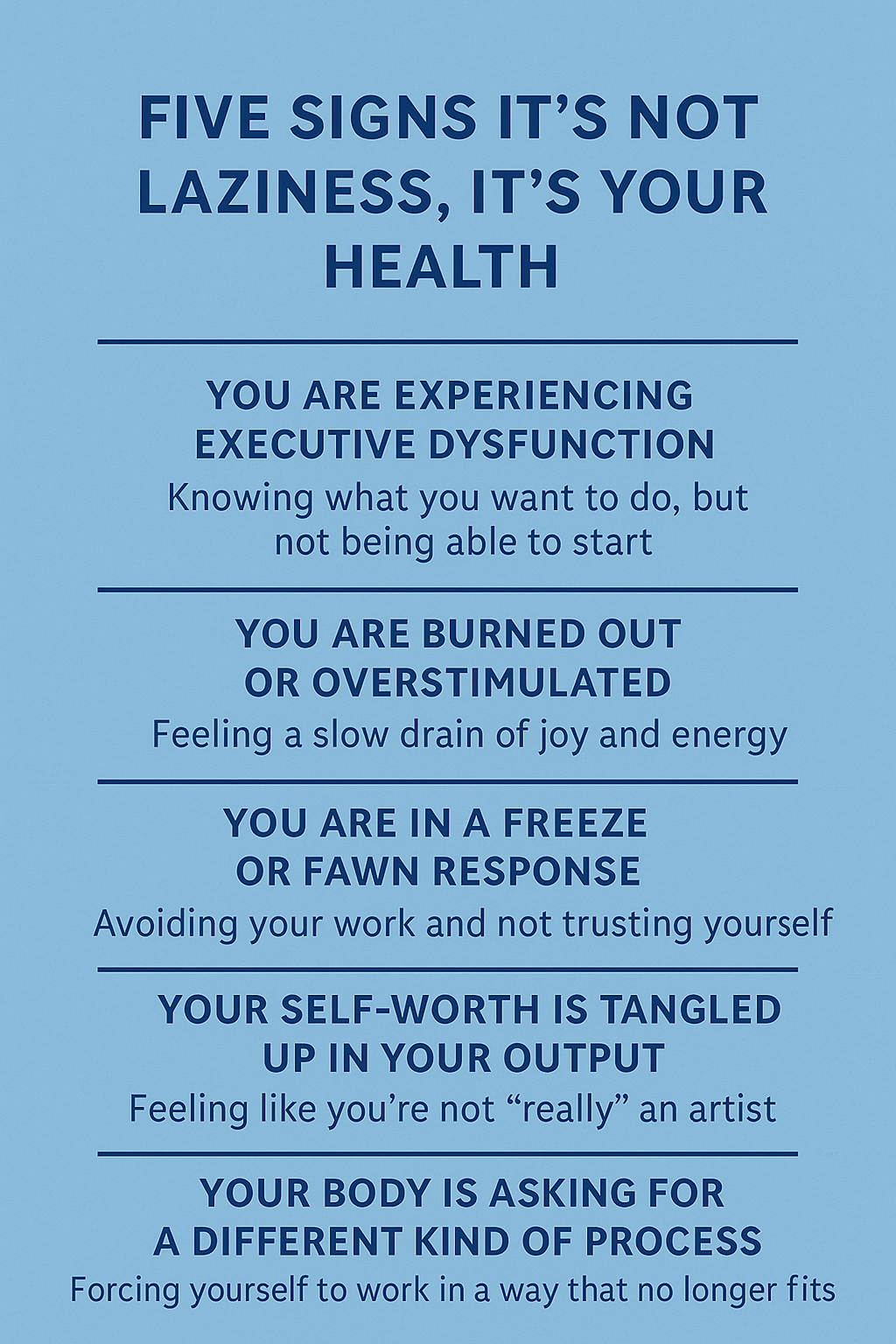
    This isn’t procrastination. It’s not a lack of discipline. More often, it’s the result of a nervous system response, specifically, a trauma- or stress-induced freeze or fawn state.

    Here’s how that works, and how I help clients find their way back.

    When Creatives Shut Down: The Nervous System’s Role

    Most people have heard of the “fight or flight” response, but those are only part of the body’s stress system. When a person perceives threat—whether physical, emotional, or psychological—the nervous system can also activate freeze or fawn states. These are especially common in people with trauma histories, chronic health conditions, or neurodivergence.

    • Freeze: The creative feels emotionally numb, foggy, and immobilized. They may report “not feeling like themselves” or describe sitting in front of their work with no internal response.

    • Fawn: The creative over-functions in response to perceived threat or rejection. This often looks like people-pleasing through art—creating to satisfy others, overcommitting to projects, or staying agreeable at the expense of authenticity.

    These responses often place the person outside their window of tolerance, the emotional zone in which they can think clearly, feel safely, and engage creatively.

    window of tolerance in creativity

    Why This Matters in Creative Work

    For many artists, writers, and entrepreneurs, creativity is more than self-expression. It’s regulation. It’s meaning-making. When they lose access to that connection, it can trigger shame, self-doubt, and identity disruption.

    Clients in freeze or fawn often tell me:

    • “I can’t remember why I cared about this project.”

    • “I feel emotionally blank.”

    • “I don’t feel blocked, I just feel gone.”

    • “I say yes to everything even when I’m too tired to create.”

    These are not motivational problems. These are nervous system realities. And without the right kind of support, they tend to compound.

    How I Support Clients Experiencing Freeze, Fawn, or Creative Numbness

    creative unblocking

    My approach blends expressive arts techniques with principles from psychology, trauma-informed care, and narrative therapy. Here’s what that often looks like in session:

    1. Nervous system education

    We talk through what the window of tolerance is, how to recognize where they are in the stress cycle, and how that might be impacting their creative process.

    2. Shame-free creative reframing

    Instead of forcing productivity, we identify the protective function of the shutdown. Together, we reframe the client’s numbness as an invitation to rest, listen, or change direction—not a personal flaw.

    3. Gentle sensory-based reentry

    I help clients reconnect with creativity through low-pressure activities that reawaken tactile engagement, such as fiber work, collage, or voice journaling. This often builds the bridge back to deeper work.

    4. Identity repair

    When someone has been in freeze or fawn for a long time, their creative identity often suffers. We do the work of remembering who they are—not just through what they make, but through how they relate to the act of making.

    This Work Is for Creatives and Those Who Support Them

    I work with self-employed artists, full-time writers, therapists, neurodivergent creatives, and people returning to creativity after illness or trauma. My sessions are not therapy, but they are trauma-aware, compassionate, and based on an understanding of how health impacts art.

    If you are a therapist or coach looking for creative-adjacent support for your clients, I also offer consultation and collaboration.

    Book a Session or Reach Out

    If you or someone you support is navigating creative numbness, identity disruption, or freeze states, I can help.

    Book a Session with Me Today

    Understanding is the first step. From there, we build a path back to creative connection that honors your nervous system and your truth.

  • How Mental Health Affects Creative Motivation: What Looks Like Laziness Might Be Something Else

    How Mental Health Affects Creative Motivation: What Looks Like Laziness Might Be Something Else

    How Mental Health Affects Creative Motivation

    Understanding the real reasons artists, writers, and makers struggle to create, and how to support them

    If you’re a creative professional or someone who supports creatives, you’ve likely heard this before:

    “I just can’t seem to get started.”
    “I know what I want to make, but I’m not doing it.”
    “I feel like I’m lazy, but I know that’s not really true.”

    When a creative person stops making, it’s easy to assume the problem is motivation or discipline. But in my work with artists, writers, and makers, I’ve seen a different story emerge. Often, the perceived laziness is actually a symptom of something deeper.

    Whether you are experiencing these struggles yourself or work with creatives in a therapeutic, coaching, or teaching role, this post outlines how mental and physical health challenges disrupt the creative process. It also offers a more compassionate and effective way to respond.

    When “Laziness” Is Really Something Else

    In my private sessions, I work with creatives navigating anxiety, depression, ADHD, chronic illness, trauma, burnout, or neurodivergence. They are sensitive, thoughtful, and often deeply committed to their work. Yet they find themselves blocked, inconsistent, overwhelmed, or disconnected from the creative identity they once held closely.

    This is not about resistance for the sake of resistance. It is about:

    • Executive dysfunction that makes task initiation feel impossible

    • Sensory overload that prevents sustained focus

    • Burnout or nervous system exhaustion that drains emotional capacity

    • Internalized shame from not being “productive enough”

    • Unrealistic expectations about how creativity is supposed to look

    These are not character flaws. They are common experiences for people living with mental health or chronic physical conditions. Yet because creative culture often glorifies constant output, these artists tend to feel like they are falling short.

    How Mental Health Affects Creative Motivation
    How Mental Health Affects Creative Motivation

    What Creative Support Should Actually Look Like

    Support for blocked or inconsistent creatives must acknowledge the realities of health and nervous system regulation. In my one-on-one sessions, I take a flexible, integrative approach grounded in psychology and expressive arts. This often includes the following:

    1. Reframing the Narrative

    Many clients hold the belief that inconsistency means failure. Together, we examine where that story originated and begin to replace it with a more humane and sustainable perspective. Motivation becomes less about pressure and more about alignment.

    2. Identifying Hidden Patterns

    Avoidance, perfectionism, and shutdown often stem from protective patterns. These patterns may have helped in the past but now stand in the way of creative engagement. By identifying them with curiosity, we can develop strategies that are supportive instead of punishing.

    3. Exploring Adaptive Practices

    Sometimes the usual creative tools or routines no longer match a person’s current capacity. I help clients experiment with new formats, flexible timelines, or sensory-based approaches that support their emotional and physical needs.

    4. Validating Cyclical Rhythms

    Creative timelines are rarely linear, especially when health is part of the equation. In session, we create realistic plans that account for energy fluctuations and emotional labor. This gives clients permission to pause without losing momentum or self-trust.

    Who These Sessions Are For

    My 1:1 Creativity and Wellness Sessions are designed for:

    • Creatives who feel blocked, inconsistent, or ashamed of not producing

    • Artists navigating illness, burnout, or neurodivergence

    • Writers experiencing emotional or sensory overwhelm

    • Therapists, coaches, and facilitators seeking support for creative clients

    • Anyone looking to rebuild their creative identity with clarity and care

    Sessions are personalized and collaborative. I draw on my Master’s degree in Psychology, my lived experience managing a chronic mental health condition, and extensive training in narrative therapy, expressive arts, and somatic awareness.

    You Don’t Have to Push Through Alone

    If you are feeling disconnected from your creative work, or you are trying to support someone who is, I want to offer a new possibility. What looks like laziness may actually be a misinterpreted survival response. What seems like inconsistency may be the nervous system asking for rest, ritual, or redirection.

    There is a way to reconnect with creativity that honors the truth of your experience. You do not have to meet impossible standards. You do not have to do this alone.

    Book Your First Session With Me Today