Tag: nervous system and creativity

  • A Framework for Creative Health: Six Dimensions of Insight and Reconnection

    A Framework for Creative Health: Six Dimensions of Insight and Reconnection

    six ways health impacts art

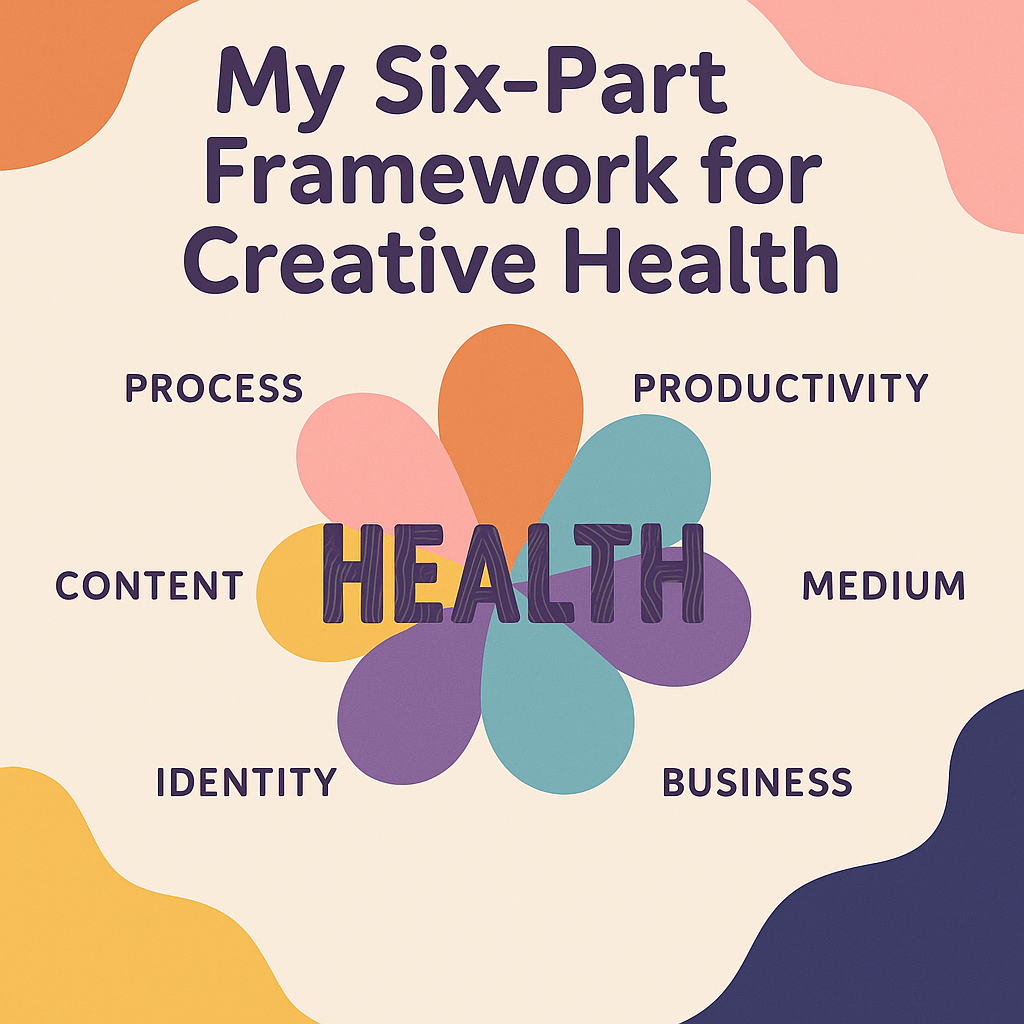
    When creatives come to me feeling blocked, inconsistent, or confused about who they are in their work, what we uncover is often far deeper than a temporary disruption in motivation. What we are seeing is a change in creative health—an interwoven network of patterns, needs, and beliefs that shape how a person relates to their art. This six-part framework offers a reflective structure to help name and explore these changes. Each domain is a point of inquiry, not a diagnostic category. The purpose is not to fix what is not working, but to understand what the work is responding to.

    1. Creative Process

    This refers to the how of your work. How do you approach making? What rhythms, rituals, or environments support your ability to enter a creative state? For many people, process becomes a source of anxiety when old methods stop working. Maybe you used to thrive on early mornings or long uninterrupted stretches, but now your health, schedule, or cognitive patterns require shorter, less structured sessions. This does not mean you are less committed. It means your process is asking to be reconfigured in a way that honors your current reality.

    2. Productivity Patterns

    Here we explore the when and how much. Creative identities are often tied to output, but this framing can collapse under the weight of chronic illness, burnout, or shifting priorities. Are you expecting yourself to work at a pace that no longer matches your capacity? Are you equating slow periods with failure? Noticing the mismatch between expectation and ability is essential. Productivity is not a measure of worth. It is a reflection of energy, accessibility, and alignment.

    3. Medium or Modality

    Sometimes the work itself wants to change form. This might mean shifting from writing to movement, from performance to collage, or from digital to tactile materials. These changes are not arbitrary. They reflect subtle psychological needs—whether for containment, expression, safety, or control. In my own experience, I have turned to fiber arts when language felt too sharp. Stitching became the way I reentered creative space when words could not yet hold what I was feeling. When your primary medium no longer feels accessible, it may be time to ask what your nervous system is reaching toward instead.

    4. Creative Content

    This is the what of your work. What themes or truths are you exploring, and have those themes shifted? Many creatives experience discomfort when they no longer feel drawn to the same subjects. They may feel bored, emotionally distant, or even resistant to what they once felt called to express. This is natural. We change. Our stories deepen or move. Allowing your content to evolve can feel risky, especially if your public identity has been tied to a particular genre or topic. But that evolution is often where your most honest work begins.

    5. Self-Perception

    This domain focuses on how you see yourself in relation to your creativity. Do you still identify as an artist, a writer, a maker, if you are producing less or working differently? Many clients carry shame around changing output or style because they have internalized narrow definitions of what it means to be a real creative. Revisiting and updating those definitions is often the most healing work we do. You are not required to create in the same way forever in order to be legitimate. You are allowed to shift and still belong to your creative identity.

    6. Sustainability and Long-Term Support

    Finally, we look at whether your creative life is built in a way that supports longevity. Can you keep doing what you are doing without crashing? Are your systems, boundaries, and goals aligned with your physical and emotional health? This is often the point where the body speaks loudest. A sustainable practice is one that leaves room for fluctuation, for illness, for grief, and for joy. It does not ask you to be consistent above all else. It asks you to be honest, supported, and resourced.

    Want to work on this with me? Book a session now.

  • How Freeze, Fawn, and Emotional Shutdown Impact the Creative Process

    How Freeze, Fawn, and Emotional Shutdown Impact the Creative Process

    creative stress responses

    Understanding trauma responses in creative professionals and how to offer meaningful support

    Creative people are often described as expressive, passionate, and emotionally driven. But what happens when they go quiet? What happens when the writer no longer writes, the artist avoids the studio, or the maker forgets what it feels like to create?

    In my work as a creative wellness guide, I meet clients who aren’t creatively blocked in the traditional sense. They’re not resisting their work. They’re disconnected from it. They’re not overwhelmed by deadlines. They’re overwhelmed by silence. Many describe feeling numb, flat, or emotionally distant from the work that once brought them joy.

    This isn’t procrastination. It’s not a lack of discipline. More often, it’s the result of a nervous system response, specifically, a trauma- or stress-induced freeze or fawn state.

    Here’s how that works, and how I help clients find their way back.

    When Creatives Shut Down: The Nervous System’s Role

    Most people have heard of the “fight or flight” response, but those are only part of the body’s stress system. When a person perceives threat—whether physical, emotional, or psychological—the nervous system can also activate freeze or fawn states. These are especially common in people with trauma histories, chronic health conditions, or neurodivergence.

    • Freeze: The creative feels emotionally numb, foggy, and immobilized. They may report “not feeling like themselves” or describe sitting in front of their work with no internal response.

    • Fawn: The creative over-functions in response to perceived threat or rejection. This often looks like people-pleasing through art—creating to satisfy others, overcommitting to projects, or staying agreeable at the expense of authenticity.

    These responses often place the person outside their window of tolerance, the emotional zone in which they can think clearly, feel safely, and engage creatively.

    window of tolerance in creativity

    Why This Matters in Creative Work

    For many artists, writers, and entrepreneurs, creativity is more than self-expression. It’s regulation. It’s meaning-making. When they lose access to that connection, it can trigger shame, self-doubt, and identity disruption.

    Clients in freeze or fawn often tell me:

    • “I can’t remember why I cared about this project.”

    • “I feel emotionally blank.”

    • “I don’t feel blocked, I just feel gone.”

    • “I say yes to everything even when I’m too tired to create.”

    These are not motivational problems. These are nervous system realities. And without the right kind of support, they tend to compound.

    How I Support Clients Experiencing Freeze, Fawn, or Creative Numbness

    creative unblocking

    My approach blends expressive arts techniques with principles from psychology, trauma-informed care, and narrative therapy. Here’s what that often looks like in session:

    1. Nervous system education

    We talk through what the window of tolerance is, how to recognize where they are in the stress cycle, and how that might be impacting their creative process.

    2. Shame-free creative reframing

    Instead of forcing productivity, we identify the protective function of the shutdown. Together, we reframe the client’s numbness as an invitation to rest, listen, or change direction—not a personal flaw.

    3. Gentle sensory-based reentry

    I help clients reconnect with creativity through low-pressure activities that reawaken tactile engagement, such as fiber work, collage, or voice journaling. This often builds the bridge back to deeper work.

    4. Identity repair

    When someone has been in freeze or fawn for a long time, their creative identity often suffers. We do the work of remembering who they are—not just through what they make, but through how they relate to the act of making.

    This Work Is for Creatives and Those Who Support Them

    I work with self-employed artists, full-time writers, therapists, neurodivergent creatives, and people returning to creativity after illness or trauma. My sessions are not therapy, but they are trauma-aware, compassionate, and based on an understanding of how health impacts art.

    If you are a therapist or coach looking for creative-adjacent support for your clients, I also offer consultation and collaboration.

    Book a Session or Reach Out

    If you or someone you support is navigating creative numbness, identity disruption, or freeze states, I can help.

    Book a Session with Me Today

    Understanding is the first step. From there, we build a path back to creative connection that honors your nervous system and your truth.