Tag: chronic illness and creativity

  • Creative Procrastination Isn’t a Problem

    Creative Procrastination Isn’t a Problem

    Why delaying your creative work is often a form of intelligence, not failure

    Why delaying your creative work is often a form of intelligence, not failure

    Procrastination is one of the most common concerns creatives bring into my sessions.

    “I don’t know why I keep avoiding this project.”
    “I’ve been staring at the same page for weeks.”
    “I want to make something, but I can’t get started.”

    In creative culture, and especially in professional spaces, procrastination is often framed as laziness or resistance. But what I’ve found, both in my own work and with the artists and writers I support, is that procrastination is rarely the real issue. It’s a signal. A protective strategy. A nervous system adaptation trying to help.

    In other words, creative procrastination isn’t a problem. It’s a pattern. And like all patterns, it can be understood, honored, and reworked into something more aligned.

    Why Creatives Delay (Even When They Care Deeply About the Work)

    When someone delays creative work, it’s usually for one of the following reasons:

    • Their nervous system doesn’t feel safe enough to begin

    • Their perfectionism has overridden their sense of play

    • Their internal critic is louder than their curiosity

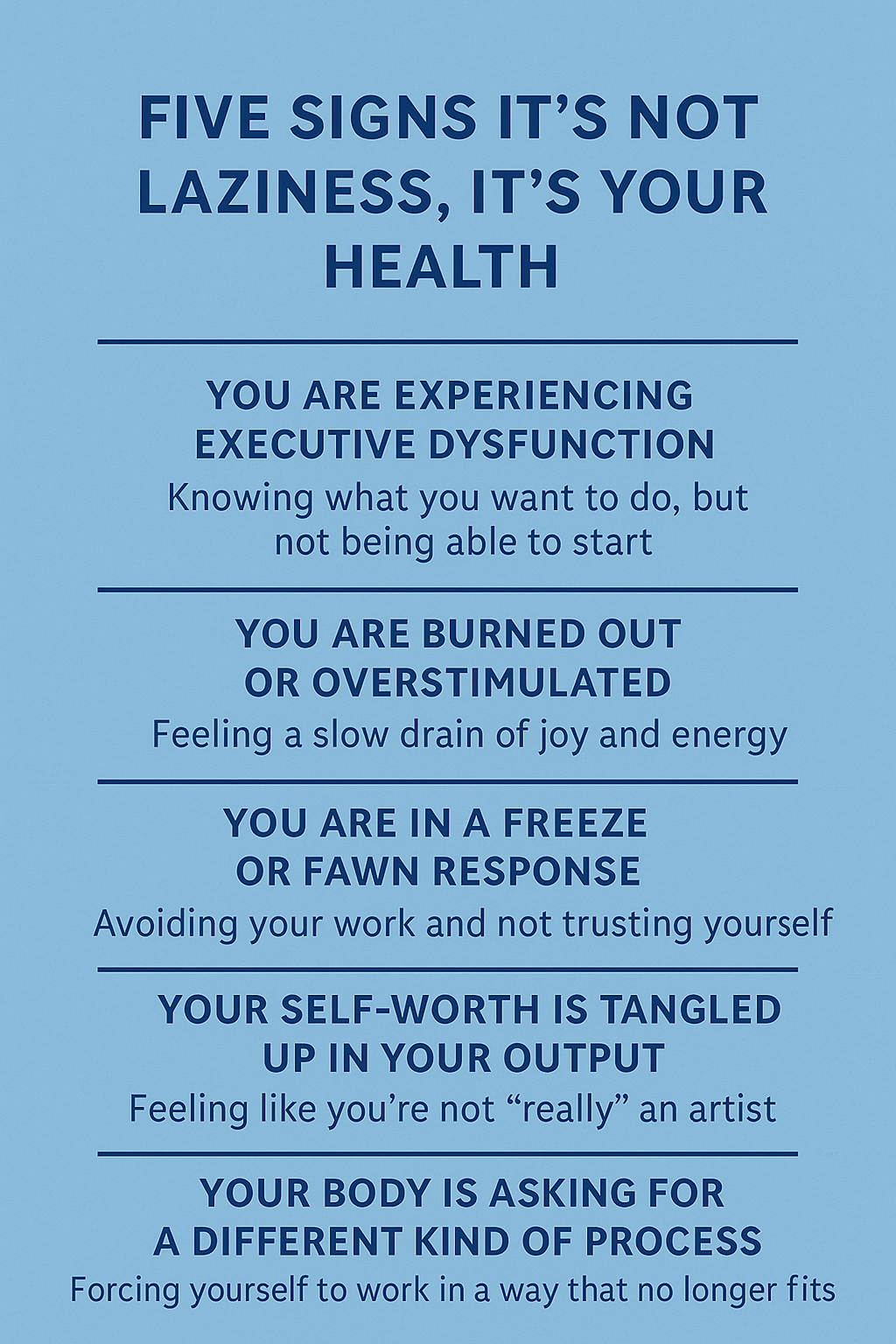
    • Their body or mind is in a state of overwhelm, freeze, or fawn

    • The emotional cost of starting feels too high to risk

    These reasons are not excuses. They are context. They often originate from lived experiences of trauma, burnout, rejection, or identity suppression.

    Procrastination, in these cases, is the body’s way of saying:

    “This might hurt. I’m not ready. Please wait.”

    That message deserves respect. It also deserves tools that help creatives move forward at a pace that doesn’t trigger collapse.

    procrastination and creative productivity

    The Role of the Nervous System in Creative Avoidance

    Many of the creatives I work with live with chronic illness, neurodivergence, or trauma histories. Their nervous systems are not always operating in the background. Often, they are central players in how (and when) creative work gets done.

    A person in fight or flight may push themselves through deadlines, then crash.
    A person in freeze may go numb and call it laziness.
    A person in fawn may agree to projects they cannot complete without depletion.

    Understanding these patterns allows us to reframe procrastination. It is not resistance to creativity. It is an attempt to regulate safety. And once that need is recognized, the solution is not to push harder. It is to meet the body where it is.

    A More Helpful Question Than “Why Am I Delaying?”

    Instead of asking “Why can’t I just do it?” I help clients ask:

    • What does this delay protect me from?

    • What would I need to feel safe enough to start?

    • What does the task represent emotionally?

    • What is the smallest first step that feels accessible?

    • Can I approach this as an experiment, not a test?

    Often, these questions uncover deeper creative truths. They also create pathways back to the work that are grounded in care, not pressure.

    procrastination isn't a creative problem

    What This Means for You or Your Clients

    If you are a creative person who struggles with procrastination, or if you support people who do, consider this:

    You may not need to fix the delay.
    You may need to understand the story behind it.
    And once that story is named, the work can begin—gently, differently, and in your own time.

    In my 1:1 Creativity and Wellness Sessions, we explore the emotional, psychological, and physical context of your creative life. We look at where avoidance shows up, what it is trying to do for you, and how to shift it without shame. This is not productivity coaching. It is permission to return to your work with softness and strategy.

    Book a Call Today

    You do not have to push through. You just have to begin where you are.

  • How Mental Health Affects Creative Motivation: What Looks Like Laziness Might Be Something Else

    How Mental Health Affects Creative Motivation: What Looks Like Laziness Might Be Something Else

    How Mental Health Affects Creative Motivation

    Understanding the real reasons artists, writers, and makers struggle to create, and how to support them

    If you’re a creative professional or someone who supports creatives, you’ve likely heard this before:

    “I just can’t seem to get started.”
    “I know what I want to make, but I’m not doing it.”
    “I feel like I’m lazy, but I know that’s not really true.”

    When a creative person stops making, it’s easy to assume the problem is motivation or discipline. But in my work with artists, writers, and makers, I’ve seen a different story emerge. Often, the perceived laziness is actually a symptom of something deeper.

    Whether you are experiencing these struggles yourself or work with creatives in a therapeutic, coaching, or teaching role, this post outlines how mental and physical health challenges disrupt the creative process. It also offers a more compassionate and effective way to respond.

    When “Laziness” Is Really Something Else

    In my private sessions, I work with creatives navigating anxiety, depression, ADHD, chronic illness, trauma, burnout, or neurodivergence. They are sensitive, thoughtful, and often deeply committed to their work. Yet they find themselves blocked, inconsistent, overwhelmed, or disconnected from the creative identity they once held closely.

    This is not about resistance for the sake of resistance. It is about:

    • Executive dysfunction that makes task initiation feel impossible

    • Sensory overload that prevents sustained focus

    • Burnout or nervous system exhaustion that drains emotional capacity

    • Internalized shame from not being “productive enough”

    • Unrealistic expectations about how creativity is supposed to look

    These are not character flaws. They are common experiences for people living with mental health or chronic physical conditions. Yet because creative culture often glorifies constant output, these artists tend to feel like they are falling short.

    How Mental Health Affects Creative Motivation
    How Mental Health Affects Creative Motivation

    What Creative Support Should Actually Look Like

    Support for blocked or inconsistent creatives must acknowledge the realities of health and nervous system regulation. In my one-on-one sessions, I take a flexible, integrative approach grounded in psychology and expressive arts. This often includes the following:

    1. Reframing the Narrative

    Many clients hold the belief that inconsistency means failure. Together, we examine where that story originated and begin to replace it with a more humane and sustainable perspective. Motivation becomes less about pressure and more about alignment.

    2. Identifying Hidden Patterns

    Avoidance, perfectionism, and shutdown often stem from protective patterns. These patterns may have helped in the past but now stand in the way of creative engagement. By identifying them with curiosity, we can develop strategies that are supportive instead of punishing.

    3. Exploring Adaptive Practices

    Sometimes the usual creative tools or routines no longer match a person’s current capacity. I help clients experiment with new formats, flexible timelines, or sensory-based approaches that support their emotional and physical needs.

    4. Validating Cyclical Rhythms

    Creative timelines are rarely linear, especially when health is part of the equation. In session, we create realistic plans that account for energy fluctuations and emotional labor. This gives clients permission to pause without losing momentum or self-trust.

    Who These Sessions Are For

    My 1:1 Creativity and Wellness Sessions are designed for:

    • Creatives who feel blocked, inconsistent, or ashamed of not producing

    • Artists navigating illness, burnout, or neurodivergence

    • Writers experiencing emotional or sensory overwhelm

    • Therapists, coaches, and facilitators seeking support for creative clients

    • Anyone looking to rebuild their creative identity with clarity and care

    Sessions are personalized and collaborative. I draw on my Master’s degree in Psychology, my lived experience managing a chronic mental health condition, and extensive training in narrative therapy, expressive arts, and somatic awareness.

    You Don’t Have to Push Through Alone

    If you are feeling disconnected from your creative work, or you are trying to support someone who is, I want to offer a new possibility. What looks like laziness may actually be a misinterpreted survival response. What seems like inconsistency may be the nervous system asking for rest, ritual, or redirection.

    There is a way to reconnect with creativity that honors the truth of your experience. You do not have to meet impossible standards. You do not have to do this alone.

    Book Your First Session With Me Today